The disappearance of the Lady was not accomplished by changing a divine title or removing a single verse.
It involved a complete reordering of sacred life: which places could be called holy, who possessed the authority to interpret God, which rituals were permitted, and which memories would be preserved as faithful Israelite religion.
The biblical account locates the decisive turning point during the reign of King Josiah of Judah, near the end of the seventh century BCE.
Josiah is remembered within the book of Kings as an extraordinary reformer who restored the nation to covenant faithfulness. From the perspective of the biblical writers, his actions cleansed the Temple and rescued Judah from idolatry.
But history becomes more complicated when we ask what his reform actually removed, whose authority it strengthened, and how the movement surrounding him influenced the biblical record through which we now remember Israel’s past.
A map of the transformation
The Anatomy of the Burial
The Lady’s disappearance was not one isolated act. It unfolded through four connected movements that changed sacred space, religious authority, theological language, and inherited memory.
I✦
Physical Removal
The Asherah and her ritual world were carried out of the Temple, destroyed, and reduced to dust.
The image was removed.II◇
Centralized Authority
Local sanctuaries were dismantled as legitimate worship became concentrated in Jerusalem.
Access moved to one center.III△
Theological Reclassification
Practices once present within Israelite religion were recategorized as foreign, corrupt, or idolatrous.
The older world became forbidden.IV◉
Editorial Reshaping
Earlier kings, symbols, and traditions were interpreted through the theology of the reform.
Memory inherited the victors’ lens.
The catalyst
The Book Found in the Temple
According to 2 Kings 22, Josiah ordered repairs to the Jerusalem Temple. During the restoration, the high priest Hilkiah announced that he had discovered a “book of the law” within the Temple.
When the book was read before Josiah, the king tore his clothing in distress. He believed Judah had violated the covenant and stood under divine judgment.
Josiah’s officials then brought the scroll to Huldah, a recognized female prophet living in Jerusalem. She confirmed that judgment was coming upon the nation, while assuring Josiah that it would not occur during his lifetime because he had responded with humility.
Huldah’s presence is important. This history cannot be reduced to a simple story of men suppressing women. A woman carrying acknowledged prophetic authority validated the scroll that became the foundation of the reform. Gender, priesthood, politics, and theology intersected in ways far more complicated than a single opposition between masculine and feminine power.
Many biblical scholars believe that the scroll described in this account was an early form of Deuteronomy, particularly the legal material found in chapters 12–26. Deuteronomy insists that legitimate sacrifice must occur at the one place chosen by Yahweh. Within the later history of Judah, that chosen place becomes Jerusalem.
One God. One authorized sanctuary. One covenantal law. One center of interpretation.
This vision would become foundational to later Judaism. At the time, however, it placed older local sanctuaries, inherited customs, household practices, and competing priestly traditions outside the boundaries of acceptable worship.
◇the decree enters sacred space◇
Physical removal
When Reform Entered the Temple
Josiah’s campaign did not stop at teaching new religious ideas. Second Kings 23 describes an extensive program of physical destruction.
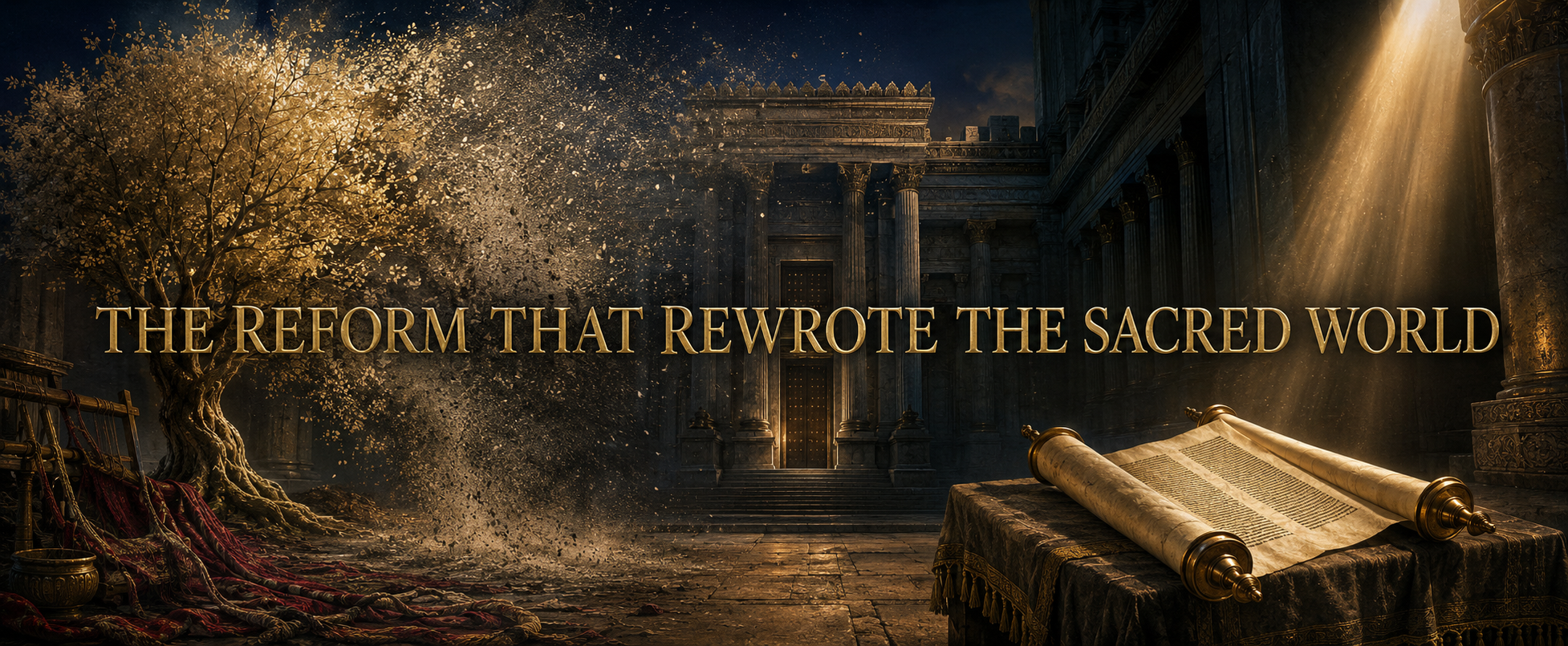
Objects made for Baal, Asherah, and the heavenly host were carried out of the Jerusalem Temple and burned. The Asherah was removed, taken to the Kidron Valley, reduced to ashes, and its dust scattered. The spaces where women wove for the Asherah were torn down. Local sanctuaries were desecrated. Priests who had served outside Jerusalem were displaced, and some religious officials were killed.
Josiah also dismantled altars traditionally associated with earlier kings. He destroyed the high place at Bethel, a major sanctuary tied to the history of the northern kingdom of Israel. He defiled Topheth in the Valley of Hinnom so that it could no longer be used for child sacrifice.
The reform therefore addressed practices that modern readers would evaluate very differently. It opposed child sacrifice and forms of worship directed toward several divine beings. It also dismantled local religious life, consolidated ritual power in Jerusalem, and destroyed the Asherah.
This is why we must resist turning Josiah into either a flawless hero or a simple villain. Religious reforms can correct genuine abuses while also erasing dimensions of a tradition that later generations may struggle to recover.
Centralized authority
One Temple, One Authorized Memory
Before centralization, sacred life did not belong only to Jerusalem.
Families maintained household practices. Villages possessed local shrines. Priests and Levites served in different regions. People encountered Yahweh through customs embedded in land, ancestry, agriculture, fertility, family life, and the rhythms of ordinary existence.
Centralizing worship changed more than geography. It changed who controlled access to the sacred.
When local altars were declared illegitimate, the authority of Jerusalem increased. The royal court and Temple priesthood gained greater power to define which practices represented Yahweh and which should be condemned as idolatry. Religious offerings, pilgrimage, sacrifice, legal interpretation, and national identity became increasingly organized around one center.
The book of Deuteronomy gives this centralization theological force. Its laws do not present Jerusalem by name, but repeatedly speak of the place Yahweh will choose for the Divine Name to dwell. The historical books eventually identify that place with the Jerusalem Temple.
This movement produced one of the most significant transformations in biblical religion: God’s presence was no longer to be encountered through a network of local sacred places, but through a centralized covenantal order governed by authorized law.
Her associations with trees, household religion, fertility, local sanctuaries, women’s ritual activity, and older conceptions of divine relationship made her incompatible with the developing theology of exclusive Yahweh worship.
𐂷the sacred tree passes from sight𐂷
The editorial lens
The Deuteronomistic Memory
The books of Joshua, Judges, Samuel, and Kings do more than report history. They interpret it.
Biblical scholars commonly use the term Deuteronomistic History for the larger narrative shaped by the theological concerns found in Deuteronomy. Within this framework, kings are judged according to whether they supported exclusive worship of Yahweh, opposed other deities, removed local high places, and upheld centralized covenantal law.
“Before him there was no king like him, who turned to the Lord with all his heart, with all his soul, and with all his might, according to all the law of Moses; nor did any like him arise after him.” 2 Kings 23:25
Once we recognize the perspective of the writers, earlier Israelite history begins to look different.
The repeated condemnation of Asherah tells us what the editors rejected. It does not necessarily tell us how every earlier Israelite understood her. Practices that may once have existed within accepted or royal forms of religion are remembered through the judgment of later authorities who had already decided that those practices were foreign to true worship.
A tradition does not need to be removed from every surviving text to be buried. Its symbols can remain while their meaning is recoded. Its adherents can be remembered only as apostates. Its sacred objects can appear only at the moment of their destruction. Its history can survive primarily through the testimony of those committed to its elimination.
The narrowing of Divine language
How the Feminine Became Theologically Unacceptable
The reform did not remove every feminine metaphor for God. The Hebrew scriptures would continue to compare God with a mother giving birth, comforting a child, nursing, protecting, and gathering her young. Women such as Huldah could still possess prophetic authority.
What became increasingly unacceptable was something more specific: an acknowledged feminine divine figure occupying sacred space alongside Yahweh.
The difference matters.
Feminine qualities could still be attributed to God. Women could still appear as prophets, judges, poets, and Wisdom teachers. But the possibility that the Divine order itself included a recognizable feminine presence was pushed beyond the boundaries of authorized worship.
This is one of the mechanisms through which the Mother was buried. Her qualities were not eliminated; they were detached from an acknowledged divine identity.
Wisdom remained, but she could be interpreted as poetic personification.
Spirit remained, but she could be translated and imagined through masculine language.
The sacred tree remained, but its older relationship to the Lady could be forgotten.
Divine maternity remained, but only as a metaphor applied to a God whose recognized identity was overwhelmingly expressed as male.
✦what was removed becomes a hidden current✦
The larger reconstruction
Margaret Barker’s First Temple Theology
This is the historical rupture at the center of Margaret Barker’s work.
Barker argues that Josiah’s reform did not simply correct a collection of foreign religious practices. In her reconstruction, it dismantled an older First Temple theology that had once included the Lady, the Tree of Life, a divine council, heavenly beings, sacred anointing, royal sonship, and a more expansive understanding of the relationship between heaven and Earth.
She believes later writers associated with the Deuteronomic movement reshaped Israel’s memory so thoroughly that important elements of the older temple tradition became difficult to recognize within the Hebrew Bible. According to Barker, some of those elements survived outside the dominant textual stream through Enochic traditions, Wisdom literature, temple symbolism, and communities that resisted the theological order created by the reform.
She then makes her boldest proposal: early Christianity did not invent its temple-centered language about the Son of God, heavenly priesthood, Wisdom, anointing, and divine embodiment. It inherited fragments of the older temple world that Josiah’s reform had attempted to suppress.
Within this reconstruction, the Lady did not simply disappear. She reemerged through Wisdom, the Tree of Life, maternal images of Spirit, and eventually the Mother of the Lord.
Barker’s work is compelling because she gathers scattered details into a coherent pattern. It is also contested because some of those details come from sources written centuries apart. Her critics argue that she sometimes treats a possible connection as though it proves historical continuity.
We do not need to ignore that criticism or abandon the questions her work makes visible.
The biblical record clearly states that an Asherah stood inside the Jerusalem Temple and that Josiah’s reform destroyed it.
Historical scholarship broadly recognizes that ancient Israelite religion was more diverse than later biblical monotheism, that Asherah was honored by some Israelites and Judahites, and that centralization strengthened Jerusalem’s religious authority.
Barker’s reconstruction proposes that these facts belonged to a larger, coherent temple theology whose fragments survived into early Christianity.
The first level is textual evidence. The second is historical interpretation supported by a substantial body of scholarship. The third is a provocative reconstruction that must be evaluated piece by piece.
What survived
The Difference Between Destruction and Erasure
The Lady’s image was destroyed, but her removal was never absolute.
The writers could condemn Asherah only by naming her. They could celebrate Josiah’s purification only by recording what had occupied the Temple before he removed it. The attempt to establish one authorized religious memory inadvertently preserved traces of the world it sought to overcome.
This is why burial may be more accurate than disappearance.
What had once been visible became submerged. The sacred feminine no longer stood openly within the Temple, yet the tradition continued to speak through feminine images whenever it needed language for the mystery of creation, Wisdom, indwelling Presence, and the passage through which divine life enters the world.
The next stage of our journey follows that submerged current.
If the Lady could no longer remain within the Temple as Asherah, where did the feminine functions of the sacred go?
The answer begins within the biblical text itself, where a feminine voice calls from the crossroads and stands beside God at creation.
Sources & further reading
Follow the Evidence
2 Kings 22:3–20. Huldah’s oracle appears in verses 14–20.
 Begin Part Two ↓