Living Waters Society
Mysteries of the Divine Feminine — Recovering the Mother Principle within the Biblical TraditionBegin the journey ↓

What if the feminine dimension of God was never absent from the biblical tradition, but deliberately obscured—and has remained hidden within the tradition all along?

Most Christians inherit a picture of God shaped almost entirely by masculine language. We learn to pray to the Father, follow the Son, and speak of the Holy Spirit without ever being invited to ask whether the Divine might also be revealed through feminine imagery, language, and function.

But the biblical and historical record tells a more complicated story.

Wisdom appears as a woman who stands beside God at creation. The Hebrew word for Spirit, ruach, is grammatically feminine. Archaeology and the biblical text preserve traces of a sacred female figure called Asherah, even as later reformers worked to remove her from the worship of Judah. In later Jewish tradition, the indwelling Presence of God would be named the Shekhinah.

These figures do not all belong to the same period, and we should not collapse them into one identity. Yet together they force us to look again at a tradition far more textured than the exclusively masculine theology many of us received.

This journey follows that current through scripture, temple history, archaeology, Jewish thought, and early Christianity. If humanity bears the image of God, then the feminine cannot exist outside the Divine Reality from which all life proceeds.

You do not need a background in theology, biblical history, or ancient languages to enter this conversation. You only need a willingness to look again.

Our point of departure

Why This Journey Begins in the Jewish World

Christianity did not appear in a vacuum. Yeshua was Jewish. His earliest disciples were Jewish. The scriptures through which they understood God, creation, covenant, Wisdom, Spirit, and Messiah emerged from the worlds of ancient Israel and Second Temple Judaism.

Our journey therefore begins before Christianity had become Christianity.

Along the way, we will distinguish among ancient Israel and Judah, Second Temple Judaism, early Christianity, rabbinic Judaism, and later Jewish mysticism. These streams are related, but they are not interchangeable. Kabbalah, for example, did not yet exist in its mature medieval form during the lifetime of Yeshua.

Jewish history and scholarship are not background decoration for a Christian story. They are essential to understanding the soil from which the Christian movement grew.

A map of the inquiry

How to Read This Timeline

The names on this timeline do not describe one uninterrupted goddess tradition, nor are they all different names for the same being. They belong to distinct historical settings and literary worlds.

As we proceed, we will keep archaeology, biblical text, later Jewish interpretation, scholarly reconstruction, and our own esoteric synthesis clearly distinguished. The purpose is not to force the evidence into a predetermined conclusion. It is to notice what survived, what changed, and what the developing tradition could—or could not—continue to name.
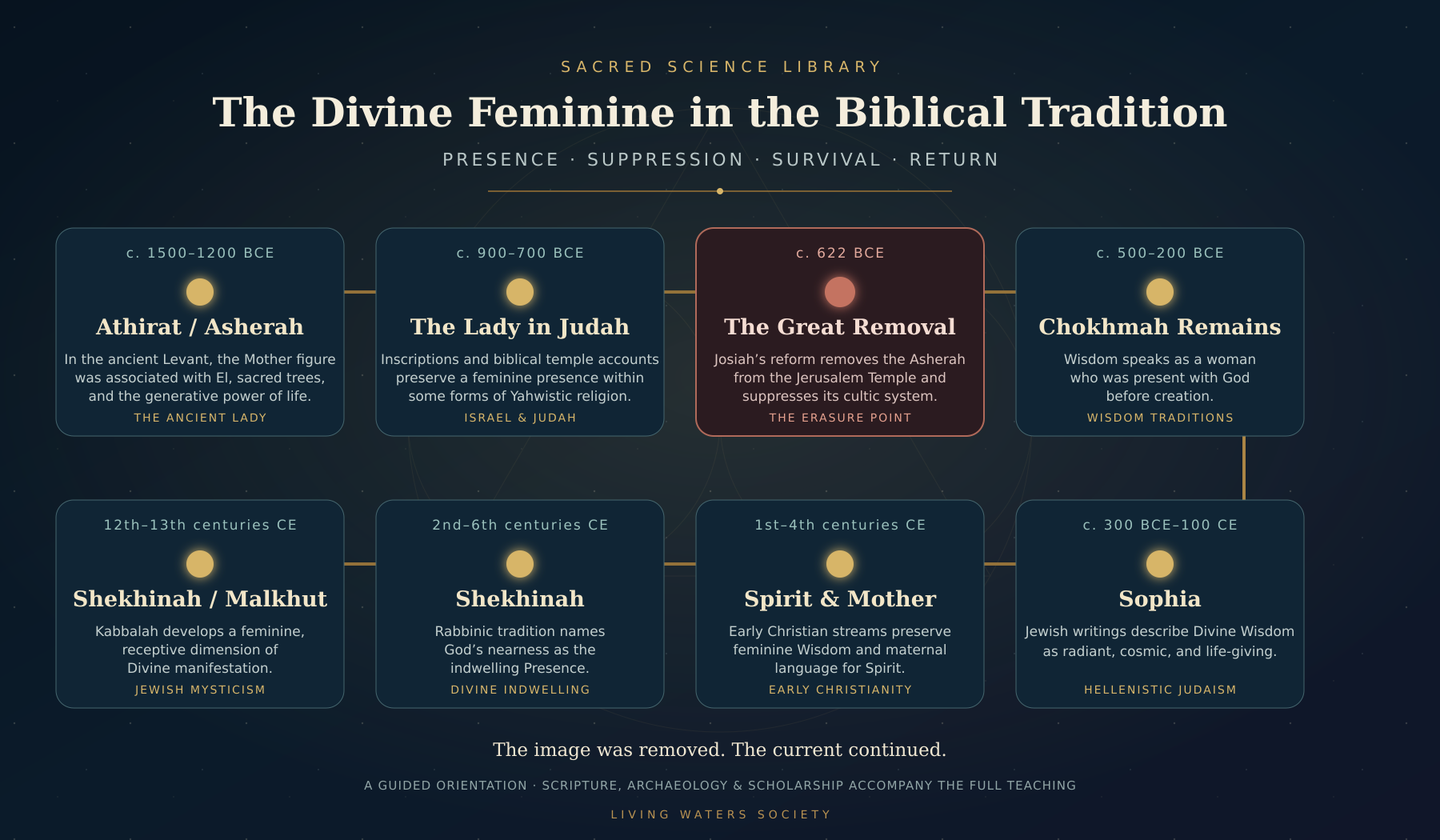
Timeline tracing feminine expressions and symbols in the biblical and Jewish traditions from Asherah through Wisdom, Spirit, and Shekhinah
A beginner’s map of the historical and symbolic current explored in this collection.

Reading the pattern

What the Timeline Reveals

The feminine does not simply disappear from the tradition. She is opposed in one form and appears again in others: as personified Wisdom, grammatically feminine Spirit, maternal imagery, and the indwelling Presence later called Shekhinah.

A decisive turning point appears in the reforms associated with King Josiah around 622 BCE, when objects connected with Asherah and other forms of worship were removed from the Jerusalem Temple. That act did more than change ritual practice. It helped reshape which expressions of Israelite religion would be authorized, remembered, and eventually read as normative.

This does not mean Asherah, Chokhmah, Sophia, ruach, and Shekhinah are simply one figure wearing different names. The historical claim must remain more careful than that. What we can observe is a recurring feminine grammar for speaking about divine presence, wisdom, generation, and nearness—even after an earlier sacred female figure had been condemned.

Was the Divine Feminine truly eliminated, or was her presence redistributed into forms the developing tradition could continue to carry?

To understand why this question matters, we must begin with the Lady whose image once stood within the sacred world of ancient Israel—and with the tree that carried her memory.

Part One · Before the Lady Became Forbidden

The Lady and the Sacred Tree

Asherah, the Temple, and the memory preserved inside the text

For many modern readers, the name Asherah is unfamiliar. When she does appear in English Bibles, translators often render the word as “pole,” “sacred pole,” or “wooden image.” That wording can make her sound like an incidental object at the edge of Israel’s story.

The evidence suggests something far more consequential.

Who Was Asherah?

In the wider religious world of the ancient Levant, Athirat—known in biblical Hebrew as Asherah—was a prominent mother goddess associated with fertility, life, and divine generation. Her precise place within Israelite religion remains debated, but both archaeology and the Hebrew Bible indicate that devotion associated with her existed among Israelites and Judahites for centuries.

This is important because the Bible does not describe Asherah as a foreign curiosity encountered only outside Israel. It repeatedly places her symbols, devotees, and cultic objects inside Israelite life—including, at times, within the Jerusalem Temple itself.

The Evidence Preserved by the Bible

The biblical writers condemn Asherah worship, but in condemning it they also preserve evidence that it was widespread. Judges, Kings, and Chronicles refer to Asherim in villages, on high places, beside altars, and under flourishing trees.

“He placed the carved image of Asherah that he had made in the house of which the Lord said… ‘In this house and in Jerusalem… I will put my name forever.’” 2 Kings 21:7

Later, 2 Kings 23 describes Josiah removing vessels made for Baal, Asherah, and the host of heaven from the Temple. It also reports that women were weaving garments or hangings for Asherah within the Temple precincts. Whatever judgment the reforming writer places upon these practices, the scene reveals that they had not been peripheral.

“Yahweh and His Asherah”

Inscriptions discovered at Kuntillet Ajrud and Khirbet el-Qom contain blessings invoking “Yahweh and his asherah.” Scholars continue to debate whether asherah in these inscriptions refers to the goddess herself, her cult symbol, or a sacred object associated with her. The ambiguity matters; responsible interpretation should not pretend the question is settled.

Yet the inscriptions still reveal a religious world more complex than a neat story in which every Israelite always practiced the later, exclusively monotheistic ideal. Some communities could speak of Yahweh alongside an asherah without experiencing the pairing as an impossible contradiction.

The Women Who Carried Her Memory

The biblical record repeatedly associates women with practices later condemned by reformers. This does not prove a single underground women’s religion, but it does suggest that women helped sustain ritual traditions tied to the sacred feminine.

When Josiah’s reform removed Asherah from the Temple, women did not merely lose an object. A ritual world in which feminine sacred agency had visible expression was being dismantled. The text allows us to glimpse that loss precisely because it celebrates the reform that caused it.

Why the Sacred Tree Matters

Asherah was closely associated with trees, wooden poles, and living vegetation. That symbolism is not accidental. The tree joins heaven and earth: rooted in soil, reaching toward light, carrying life through branches, fruit, and seed. It is a natural image of mediation, fertility, wisdom, and the generative matrix of creation.

Later biblical Wisdom literature also draws upon tree imagery. Proverbs calls Wisdom “a tree of life to those who lay hold of her.” We should not leap from that poetic image to the claim that Lady Wisdom is simply Asherah renamed. But the shared symbolic vocabulary invites a careful question: when a sacred figure is prohibited, can parts of her symbolic world survive in forms the tradition is still able to receive?

Before the Lady Became Forbidden

Asherah’s presence complicates the familiar picture of Israelite religion. It suggests that the movement toward exclusive worship of Yahweh was not a single revelation received uniformly from the beginning, but a long and contested historical development.

The biblical text we inherited was shaped in part by those who won that contest. Yet the traces of the older world were never completely erased. They remain in prohibitions, reform accounts, inscriptions, figurines, sacred-tree imagery, and the very urgency with which later writers insisted that such worship must end.

She was not removed because she had never been there.
She was removed because a new vision of authorized worship had no place for her.

The next part of this journey turns to that removal: the reform of Josiah, the centralization of worship in Jerusalem, and the theological editing that helped rewrite Israel’s sacred memory.

Sources & further reading

Follow the Evidence

  1. Judges 3:7; 1 Kings 15:13; 18:19; 2 Kings 21:7; 23:4–7. See also “What Is an Asherah?” at Bible Odyssey.
  2. David Frankel, “Aaron’s Flowering Staff: A Priestly Asherah?”, TheTorah.com.
  3. The Kuntillet Ajrud and Khirbet el-Qom inscriptions, commonly dated to the Iron Age, preserve the disputed phrase “Yahweh and his asherah.”
  4. Israelite female pillar figurine, The Metropolitan Museum of Art.
  5. Margaret Barker, The Mother of the Lord; and “What Did Josiah Reform?”
  6. “Is the Bible Reliable? A Case Study”, BYU Studies.

Continue the Journey · Part Two

The Reform That Rewrote the Sacred World

How the Lady was removed from the Temple and buried within biblical memory. →

If this current has awakened a deeper question in you, continue the conversation inside the Living Waters Society.

Enter the community